






What is REC and Why Does It Matter? A Deep Dive into I-REC Standards & EGAT’s Role in Thailand (Update 2025-2026)
In recent years, Renewable Energy Certificates (RECs) have become an essential tool for organizations seeking to use renewable energy and transparently reduce Scope 2 greenhouse gas emissions in a verifiable and internationally recognized manner. Specifically, within Thailand, REC procurement has seen continuous growth. The international I-REC standard, combined with the appointing of the Electricity Generating Authority of Thailand (EGAT) to oversee and drive the system's credibility, has strengthened the market. This article will summarize key content regarding what RECs are, how to use them, how they differ from actual consumed electricity, and why they are vital for the Net Zero goals of businesses in Thailand.
What is a Renewable Energy Certificate (REC)?
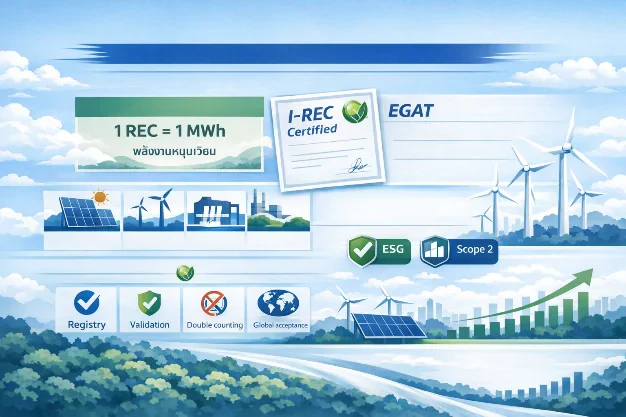
A Renewable Energy Certificate (REC) is a certificate that verifies one unit of electricity (1 REC) is equal to the production of 1 MWh of clean electricity from a renewable energy source that has been verified and certified according to international standards, such as the I-REC Standard.
The trading model for RECs is "Unbundled," meaning the "certificate" is purchased separately from the "actual consumed electricity." This allows organizations to select the quantity of RECs needed based on their ESG requirements, Scope 2 targets, and Net Zero goals without needing to physically consume energy from the same generation source as the certificate.
The REC system enables organizations to transparently claim renewable energy usage with traceability, without the need to invest in installing their own power plants or renewable energy generation systems. This facilitates an easier transition to Renewable Energy and is suitable for large corporations, SMEs, and even rented office spaces, all of whom can make valid claims.
Renewable Energy Technologies Certified for RECs in Thailand
There are four approved technologies for RECs in Thailand:
- Solar
- Wind
- Hydropower
- Biomass
All these power plants must undergo registration and verification according to I-REC criteria under domestic certifiers to ensure the certificates issued are accurate and verifiable. Additional details on registration can be studied in Guidance_Registrant-Production Device-Issuance process for Registrant_V15.pdf.
What is the I-REC Standard? (International Renewable Energy Certificate Standard)
The I-REC Standard is an international system used to certify renewable energy attributes, relying on the governance mechanism of the International Tracking Standard Foundation (I-TRACK). I-TRACK defines the code of practice for issuing certificates and establishes a transparent energy tracking structure that is verifiable and traceable at every stage. Currently, I-TRACK has established various Product Codes to support the growth of the energy business and future offsetting via certificates, including:
- Product Code for Electricity (I-REC-E or I-REC)
- Product Code for CDR (Carbon Dioxide Removal) (I-TRACK – CDR)
- Product Code for Hydrogen (I-TRACK-HX)
- Product Code for Biogas (I-TRACK-G)
The strengths of I-REC include a central registry system, verification of actual energy volume produced per unit, and prevention of double-counting through a rigorous verification process. It is easily accessible via QR code verification and is accepted in international corporate energy reporting standards such as the GHG Protocol (Scope 2), RE100, and ISO 14064-1.
Highlights of the I-REC Standard
- Utilizes an international central registry system; all operations are conducted through the system, resulting in widespread registered buyers and sellers globally, particularly in Asia.
- The standard focuses specifically on electricity generation from renewable energy. Trading occurs in MWh units, similar to purchasing electricity, and involves data verification prior to registration, as well as document audits every time units are confirmed into the system.
- Prevents double-counting by auditing documents before confirming units into the system, and once a unit is converted into a certificate, it can be re-verified by its certificate serial number.
- Recognized in environmental reporting frameworks such as the GHG Protocol (Scope 2 Market-based), RE100, and ISO 14064-1.
EGAT’s Role in RECs and I-RECs in Thailand
In Thailand, the Electricity Generating Authority of Thailand (EGAT) serves as the Local Issuer, or the national verifier and certifier for RECs under the I-REC standard, having been appointed by the I-TRACK Foundation since 2020.
EGAT’s primary roles include:
- Registering renewable energy power plants in Thailand into the I-REC system.
- Verifying production data and issuing REC units into participant accounts.
- Ensuring transparency, traceability, and preventing double-counting.
- Promoting sustainable growth of the domestic REC market.
For entrepreneurs, this appointed role ensures both producers and end-users can be confident that the RECs they hold possess international credibility and can be validly referenced in environmental and sustainability reports.
The Thai REC Market Situation Driven by EGAT (Year 2025)
Since EGAT assumed the role of Local Issuer for the I-REC standard, the Thailand Renewable Energy Certificate (REC) market has continued to grow and become more transparent and credible. This has resulted in a clear increase in demand for renewable energy and Scope 2 reporting.
The opening of applications for the Utility Green Tariff (UGT1) project in 2025, which supports bundled REC Renewable Energy usage, has made it easier for businesses to access renewable electricity usage models. It is anticipated that REC utilization in 2025 will see exponential growth driven by ESG, Net Zero commitments, and the demand for Renewable Energy within Thai organizations.
Renewable Energy Solutions from WHA Utilities and Power Plc. (WHAUP)
WHA Utilities and Power Plc. (WHAUP) is moving forward with developing integrated Renewable Energy solutions to support the industrial sector in reducing energy costs, enhancing energy security, and driving long-term sustainability goals.
Currently, WHAUP has developed and installed a combined total of over 1,026 MW of solar power generation systems, with 498 MW being Renewable Energy capacity, covering areas throughout Thailand. We support comprehensive installations in various formats, including:
- Solar Farm
- Solar Rooftop
- Solar Car Park
- Solar Floating
- Solar + BESS (Battery Energy Storage System): The latest Renewable Energy service from WHAUP, integrating solar power generation with energy storage systems to enhance grid stability, reduce renewable energy volatility, and increase flexibility in energy management. This enables the continuous use of Renewable Energy 24 hours a day (24/7).
WHAUP also provides services in the form of Solar Direct PPA (Private Power Purchase Agreement), which offers high flexibility. We can manage the entire cycle, from investment and system design to procuring installation space and selling clean electricity, under collaboration models tailored to each customer’s needs.
Furthermore, WHAUP is expanding into a Peer-to-Peer (P2P Energy Trading) platform under RENEX (Renewable Energy Trading Platform) to increase options for flexible, transparent, and efficient access to and management of Renewable Energy, supporting the transition to next-generation energy systems for the industrial sector.
WHAUP’s I-REC Business
Regarding I-RECs, WHAUP has currently registered power plants under the I-REC standard totaling over 250,000 MWh/year to support customer demand across diverse industries, covering all regions in Thailand.
If your organization is looking for pathways to transition to Renewable Energy, desires to use I-RECs, or is interested in integrated Solar Energy and Solar BESS solutions, WHA Utilities & Power (WHAUP) is ready to provide support, from suitability assessment stages and energy planning to managing your renewable energy certificates.
References